


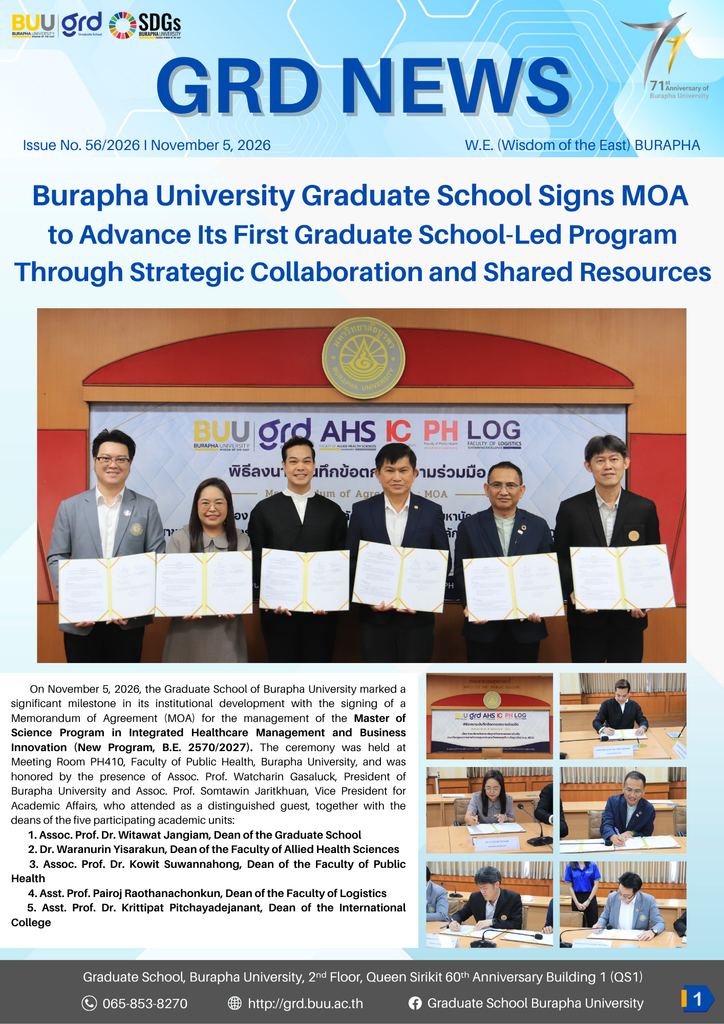
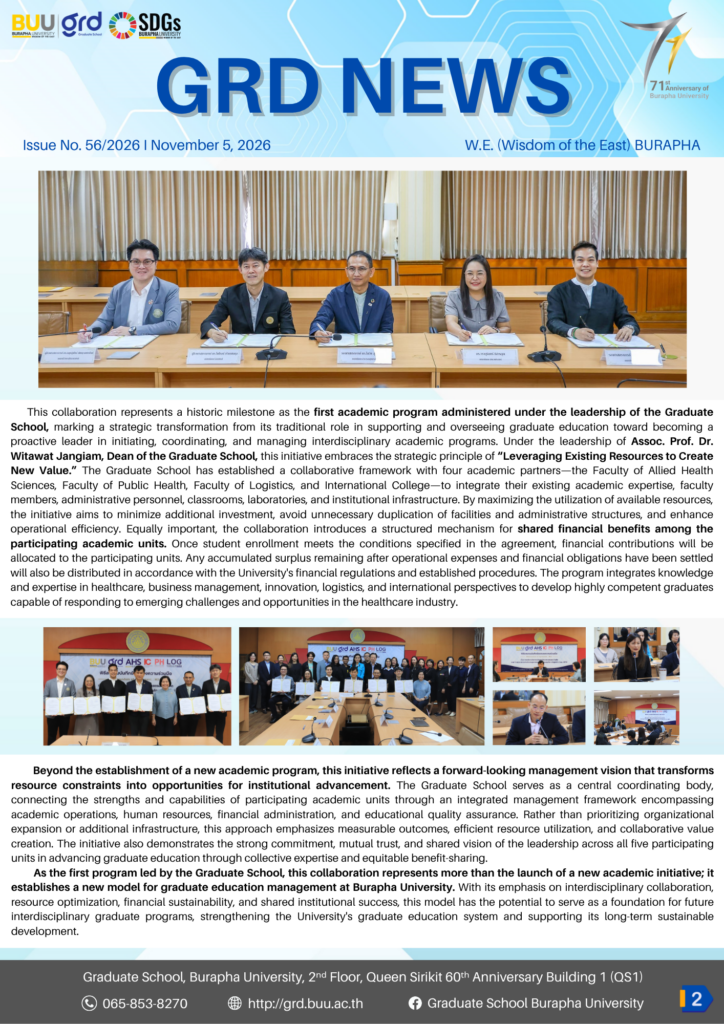
On November 5, 2026, the Graduate School of Burapha University marked a significant milestone in its institutional development with the signing of a Memorandum of Agreement (MOA) for the management of the Master of Science Program in Integrated Healthcare Management and Business Innovation (New Program, B.E. 2570/2027). The ceremony was held at Meeting Room PH410, Faculty of Public Health, Burapha University, and was honored by the presence of Assoc. Prof. Watcharin Gasaluck, President of Burapha University and Assoc. Prof. Somtawin Jaritkhuan, Vice President for Academic Affairs, who attended as a distinguished guest, together with the deans of the five participating academic units:
1. Assoc. Prof. Dr. Witawat Jangiam, Dean of the Graduate School
2. Dr. Waranurin Yisarakun, Dean of the Faculty of Allied Health Sciences
3. Assoc. Prof. Dr. Kowit Suwannahong, Dean of the Faculty of Public Health
4. Asst. Prof. Pairoj Raothanachonkun, Dean of the Faculty of Logistics
5. Asst. Prof. Dr. Krittipat Pitchayadejanant, Dean of the International College
This collaboration represents a historic milestone as the first academic program administered under the leadership of the Graduate School, marking a strategic transformation from its traditional role in supporting and overseeing graduate education toward becoming a proactive leader in initiating, coordinating, and managing interdisciplinary academic programs. Under the leadership of Assoc. Prof. Dr. Witawat Jangiam, Dean of the Graduate School, this initiative embraces the strategic principle of “Leveraging Existing Resources to Create New Value.”
The Graduate School has established a collaborative framework with four academic partners—the Faculty of Allied Health Sciences, Faculty of Public Health, Faculty of Logistics, and International College—to integrate their existing academic expertise, faculty members, administrative personnel, classrooms, laboratories, and institutional infrastructure. By maximizing the utilization of available resources, the initiative aims to minimize additional investment, avoid unnecessary duplication of facilities and administrative structures, and enhance operational efficiency. Equally important, the collaboration introduces a structured mechanism for shared financial benefits among the participating academic units. Once student enrollment meets the conditions specified in the agreement, financial contributions will be allocated to the participating units. Any accumulated surplus remaining after operational expenses and financial obligations have been settled will also be distributed in accordance with the University's financial regulations and established procedures. The program integrates knowledge and expertise in healthcare, business management, innovation, logistics, and international perspectives to develop highly competent graduates capable of responding to emerging challenges and opportunities in the healthcare industry.
Beyond the establishment of a new academic program, this initiative reflects a forward-looking management vision that transforms resource constraints into opportunities for institutional advancement. The Graduate School serves as a central coordinating body, connecting the strengths and capabilities of participating academic units through an integrated management framework encompassing academic operations, human resources, financial administration, and educational quality assurance. Rather than prioritizing organizational expansion or additional infrastructure, this approach emphasizes measurable outcomes, efficient resource utilization, and collaborative value creation. The initiative also demonstrates the strong commitment, mutual trust, and shared vision of the leadership across all five participating units in advancing graduate education through collective expertise and equitable benefit-sharing.
As the first program led by the Graduate School, this collaboration represents more than the launch of a new academic initiative; it establishes a new model for graduate education management at Burapha University. With its emphasis on interdisciplinary collaboration, resource optimization, financial sustainability, and shared institutional success, this model has the potential to serve as a foundation for future interdisciplinary graduate programs, strengthening the University's graduate education system and supporting its long-term sustainable development.